5 Hidden Signs of CEO Burnout (And How It's Quietly Costing You Money)
82% of CEOs report exhaustion indicative of burnout. Most of them are not lying on the floor - they are still working, still showing up, still serving clients. The burnout in this article does not look like collapse.
It looks like procrastination, notification dread, push-crash cycles, and the slow erosion of decision-making confidence. These five signs are invisible on a spreadsheet and devastating to a business's growth potential.
Each one has a name, a mechanism, and a measurable cost. And there is a significant gap in the market between €5,900 luxury retreats and generic wellness podcasts - almost nothing addresses CEO burnout at the structural, operational level mid-market entrepreneurs actually need. This article fills that gap.
The burnout nobody talks about
There is a version of CEO / solopreneur burnout that is easy to identify. The woman who cannot get out of bed. Who closes the laptop and does not open it again for weeks, and beats herself up. Who might follow through with her clients, but she needs a break and disappears from socials for weeks.
That version exists. It is real and it is serious.
But it is not the version most entrepreneurs are living.
The version most entrepreneurs are living is still working. Still showing up for clients, still posting, still answering messages. She has not collapsed, she is too committed, too responsible, too aware of what is at stake to let herself collapse. So instead she does something more insidious: she operates at a fraction of her capacity while doing everything in her power to make it look otherwise.
And because it does not look like burnout from the outside, it never gets named. Which means it never gets addressed. Which means the business quietly absorbs the cost - in revenue not generated, visibility tanked, decisions not made, opportunities not taken, and a growth curve that never quite reaches the potential the effort deserves.
The market has two responses to this situation.
On one end: luxury retreats at €5,900 that most mid-market entrepreneurs cannot access and that do not address the operational reality of a business that still needs to run.
On the other: money mindset courses, productivity tricks, generic wellness podcasts and self-care advice that is not wrong but is also not structural.
What is almost entirely absent is a framework that names what is actually happening at the level of the nervous system, maps how it shows up in the business, and gives a concrete operational sequence for addressing it from wherever the entrepreneur currently is.
This article starts that work. With the five signs most CEOs / solopreneurs miss, because they do not look like burnout, and because nobody has put them together and called them by their right name.
The burnout most CEOs / solopreneurs are living doesn't look like collapse. It looks like procrastination, dread, inconsistency, and second-guessing, and every single one of them is quietly costing the business money. Once you stack a couple of those burnouts on the top of each other and you have Business PTSD. Where your body shuts down.
Why CEO burnout costs money - the mechanism
Before naming the five signs, it is worth understanding why burnout has a financial cost beyond the obvious ones.
The obvious costs are easy to see: days of low productivity, missed deadlines, clients not properly served. These show up in client feedback, in deliverable quality, in the gaps visible to anyone paying attention.
The hidden costs are the ones that compound silently over months and years. They are not on any spreadsheet. They are in the decisions that never got made... The offer that never launched because the confidence was not there, the partnership that never formed because the follow-up never happened, the price increase that never got implemented because it felt too risky at a time when everything felt too risky.
They are in the quality of the decisions that did get made... Made from a depleted, dysregulated state rather than from clarity and strategic thinking. Decisions made from survival mode tend toward the conservative, the familiar, and the immediately survivable rather than the growth-oriented and the strategically sound.
And they are in the compounding effect of operating consistently below capacity. A business that runs at 60% for two years does not just lose 40% of two years' output. It loses the compounding of what that 40% would have built - the relationships not deepened, the audience not grown, the authority not established, the revenue not reinvested.
This is why CEO burnout is a business problem, not just a personal one. And why the five signs that follow matter not just for the entrepreneur's wellbeing, but for the financial health of the business she is building.
The financial cost of CEO burnout is not in the days of low productivity. It is in the decisions never made, the offers never launched, and the compound interest on two years of operating at 60%.
The 5 hidden signs and what each one is actually costing
Read each sign carefully. Notice not just whether you recognise it, but how long it has been present. The length of time matters as much as the presence, because these patterns compound.
| Sign | What it looks like | What it actually is | The business cost |
|---|---|---|---|
| Sign 1 Procrastination that feels physical |
You know exactly what to do. You have a plan. And something stops you before you even begin — a heaviness, a tightness, an inability to start that has nothing to do with willpower or discipline. | Business PTSD — the nervous system has learned that action leads to disappointment and has stepped in to protect you. This is not laziness. It is biology. | Tasks that don't get done don't generate revenue. Every day of avoidance is a day of potential income that does not materialise. Over weeks and months, this compounds invisibly into a significant revenue gap. |
| Sign 2 Dreading what used to excite you |
Launches, client calls, content creation, visibility — things you once found energising now feel heavy or even threatening. You find yourself dreading the next thing on the calendar instead of looking forward to it. | The push-crash cycle has depleted the nervous system's capacity to associate business activity with safety or positive anticipation. The body has learned: what comes next will cost more than it gives. | A CEO who dreads her own business makes smaller decisions, takes fewer risks, and shrinks the business gradually to match what feels survivable. The cumulative cost is a business operating permanently below its potential. |
| Sign 3 Panic when checking messages and notifications |
Opening email, checking DMs, seeing a notification — any of these triggers a spike of dread or anxiety before you have even read what it says. The body reacts before the mind has assessed whether there is a real threat. | Nervous system dysregulation — the body has been conditioned to associate incoming communication with potential bad news, client problems, or the gap between what was promised and what was delivered. | When checking messages feels threatening, communication slows or stops. Leads go unanswered. Follow-ups don't happen. Client relationships deteriorate through neglect. Sales are quietly lost to the anxiety of simply opening the inbox. |
| Sign 4 The push-crash cycle as your operating rhythm |
Periods of forcing yourself to work hard followed by complete collapse — days or weeks of doing almost nothing. This begins to feel like your normal, even though it is not sustainable and never produces the results the effort deserves. | The nervous system oscillating between sympathetic activation (fight or flight — forcing output) and parasympathetic shutdown (collapse — protective withdrawal). Neither state is productive in the business sense. | Inconsistency is one of the most expensive patterns in a service-based business. Audience trust erodes. Client experience becomes unpredictable. Revenue becomes impossible to forecast. The business cannot be scaled on a foundation that collapses regularly. |
| Sign 5 Loss of confidence in decisions you once made easily |
Decisions that were once instinctive now feel enormous. Pricing, content topics, which client to take, what offer to lead with — things you navigated naturally before now carry an outsized weight of uncertainty and second-guessing. | Accumulated self-blame from previous cycles of effort-and-disappointment has eroded the internal trust that confident decision-making requires. When the body believes past decisions led to failure, it becomes reluctant to commit to new ones. | Slow or avoided decisions stall the business at every level. Offers don't get launched. Partnerships don't get formed. The business waits for a confidence that the entrepreneur cannot access because the structural cause of its absence has not been addressed. |
One thing worth noting across all five signs: none of them are character flaws. None of them are evidence that the entrepreneur is not cut out for this, is not disciplined enough, or does not want it enough. Every single one is a rational, predictable response from a nervous system that has been under sustained pressure without adequate recovery and has decided, correctly from a biological standpoint, that protection is now more important than performance.
The name for this state, when these five patterns have been present long enough and intensely enough to become the operational baseline of the business, is Business PTSD.
It is not clinical PTSD. It is the specific structural residue of burnout stacking in an entrepreneurial context, when the nervous system has reorganised itself around the perceived threat of business activity.
None of these five signs are character flaws. Every one of them is a nervous system doing exactly what it was designed to do: protect you from a pattern it has learned to expect. The problem is not your character. It is the pattern.
What recovery actually looks like at an operational level
Recovery from Business PTSD is not a single event. It is not a retreat, a mindset shift, or a week off. It is a structured sequence that begins with naming, moves through diagnosis, and rebuilds the business one nervous-system-safe area at a time.
Step 1 : Name it. The five signs in this article are the starting point. Not because naming them makes them disappear, but because they cannot be addressed at a structural level until they have been identified as structural rather than personal. The most common mistake is treating these signs as motivation problems and applying motivation solutions, which adds pressure to a system that is already in protection mode, and makes every sign worse.
Step 2: Diagnose the business. Business PTSD does not affect all twelve areas of a business equally. The Wheel of Business diagnostic (introduced in previous post of this series) maps where the signs are showing up most significantly in the operational reality of the business. Procrastination that feels physical tends to affect Content Creation and Lead Generation scores most severely. Notification panic tends to affect Sales and Client Experience scores. Decision loss tends to affect Biz Operation and Analytics. The Wheel makes the pattern visible so that recovery can be sequenced correctly.
Step 3: Choose the strategy that fits where you are. Recovery is not the time for ambitious growth strategies. It is the time for nervous system-safe strategies, ones that require less of the entrepreneur than she thinks she can give, that create genuine completions rather than more pressure, and that build evidence one action at a time that the business can be operated from safety rather than survival. The Choose What Works framework (learn more about it in this previous post here) applies the five filters to every strategy candidate to ensure it matches the recovery stage, not the aspirational stage.
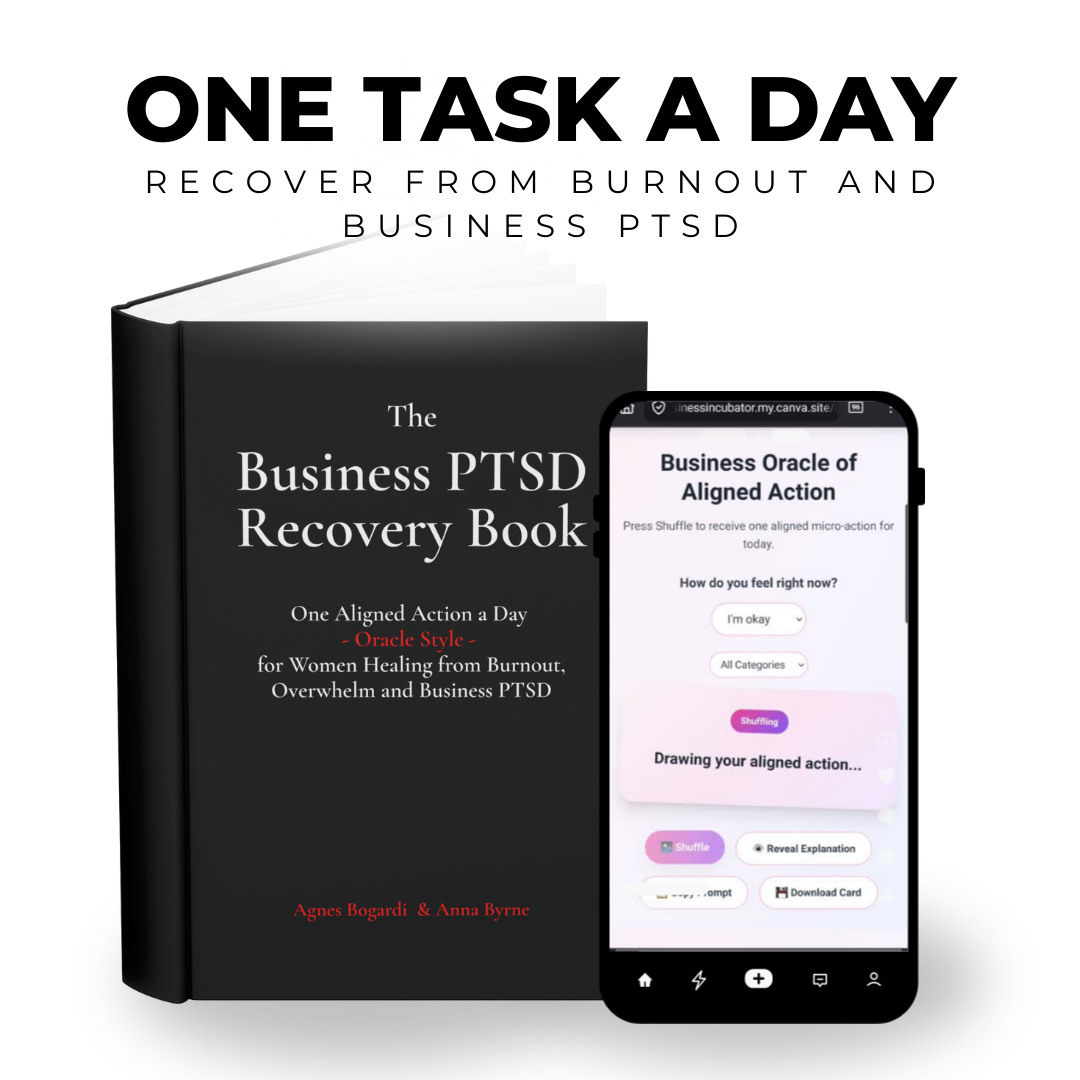
Step 4 : One completing action at a time. The Business PTSD Recovery Book was built for this step specifically, one aligned action per day, each one designed to be small enough that the nervous system can hold it and meaningful enough that it creates a genuine completing experience. Not productivity. Not output. Only Input Goals. Safety signals. The evidence the body needs to begin reassociating business activity with something other than depletion.
Recovery is not linear. It is not fast. And it does not require starting over, it requires a curated reconstruction from the foundations that already exist, using the strategies that actually match the stage the entrepreneur is in right now, not the stage she was in before the burnout or the stage she aspires to reach.
Recovery from Business PTSD is not a restart. It is a curated reconstruction, one area at a time, one completing action at a time, one safety signal at a time. The business does not have to be rebuilt from zero. It has to be rebuilt correctly. And starts with YOU!
How to know if you are recovering
Recovery from Business PTSD has observable markers. They are not the same as productivity metrics, they are nervous system signals that tell you the body is beginning to reassociate business activity with safety.
Actions feel lighter: not effortless, but lighter. The physical resistance before beginning reduces in intensity, even if it does not disappear entirely.
Decisions come back: small ones first. Confidence returns incrementally, starting with the decisions that carry the least perceived risk.
The crash phase shortens: the push-crash cycle does not end overnight, but the collapse periods become shorter and the recovery periods more productive.
Anticipation returns for individual activities: even one or two things on the calendar begin to feel interesting rather than heavy.
The inbox becomes neutral: not exciting, not dreaded. Just information to process, like it was before the pattern developed.
and you are ready to Dream again!
These markers do not all appear simultaneously. They arrive out of order, inconsistently, sometimes retreating before advancing again. Recovery is not a straight line upward, it is a gradual reorientation of the nervous system toward safety, one completing experience at a time.
The most important marker, and the one most entrepreneurs miss because it feels insufficient, is the returning sense that the business is survivable. Not thriving. Not profitable at the level aspired to. Just survivable, from a nervous system perspective. That is where recovery begins. Everything else is built on top of it.
You are not recovered when you are thriving again. You are recovering when the business starts to feel survivable again. That is the foundation everything else is built on. It is not a small thing. It is the whole thing.
Frequently asked questions
The five signs most often missed are: procrastination that feels physical (a body-level resistance to beginning, not a discipline problem), dreading activities that previously felt exciting (launches, visibility, client calls), panic or anxiety when checking notifications before reading their content, the push-crash cycle as the operating rhythm (forcing output followed by complete shutdown), and loss of confidence in decisions that were once made easily. None of these look like burnout from the outside — which is why they go unnamed and the business continues absorbing their cost.
Recovery from Business PTSD — the form of burnout most common in entrepreneurs — follows a specific sequence. First: naming the pattern correctly (not as a motivation or discipline failure but as a nervous system protection response). Second: diagnosing which areas of the business have been most affected using a structured diagnostic tool like the Wheel of Business. Third: selecting recovery-appropriate strategies through the Choose What Works framework — ones that fit current capacity, not aspirational capacity. Fourth: one completing action at a time, building safety signals that gradually reassociate business activity with something other than depletion.
Recovery is not linear and there is no universal timeline — it depends on how long the pattern has been present, how many cycles of burnout have stacked, and how quickly the structural causes are addressed. What is consistent is that recovery requires more time than most entrepreneurs allow. Observable markers of genuine recovery include actions feeling lighter, decisions returning (small ones first), the push-crash cycle shortening, and the inbox becoming neutral rather than threatening. These markers typically emerge over months, not weeks.
Yes — but not using the same strategies that caused the burnout, and not at the same pace the burnout was generated. Sustainable scaling requires three conditions: strategies matched to the entrepreneur's current stage and nervous system capacity (Choose What Works framework), operational systems that reduce the amount of the business running manually through the entrepreneur (Systems Automation in the Wheel of Business), and a recovery-first sequencing that rebuilds the body's sense of safety with business activity before growth demands are reintroduced. Scaling on top of an unaddressed Business PTSD pattern does not produce sustainable growth — it produces faster stacking of the same burnout cycle.
Start Your Recovery Today