Why is my business not growing — the Wheel of Business diagnostic and how to find what to focus on first
When a business stops growing — or never quite gains momentum despite consistent effort — the instinct is to look at what is most visible or most painful and fix that. A new content strategy. A redesigned offer. A rebrand. Another course on messaging. The problem is that the most visible issue is rarely the actual limiting factor. The Wheel of Business is a diagnostic framework developed by Agnes Bogardi that maps a business across twelve interconnected categories — and shows precisely which area, when strengthened, will unlock movement across the rest. This article introduces the Wheel, walks through all twelve categories, explains how to read your results in relation to your core goal, and gives you a five-step process for choosing where to focus first.
The most expensive mistake — fixing the wrong thing first
Here is the pattern that plays out in almost every stalled online business.
Something is not working. The entrepreneur identifies the most obvious symptom and addresses it. A new content strategy. A repositioned offer. A rebrand. More visibility. A messaging overhaul. Three months later, the symptom has shifted. The underlying problem has not.
This is not a failure of strategy. It is a failure of diagnosis. The entrepreneur fixed what was visible — not what was actually limiting the system.
A business is not a single problem. It is a system of twelve interconnected areas, each one affecting the others. When one area is underdeveloped, it creates drag across multiple others simultaneously. You can have strong content but if lead generation is absent, the content builds an audience that never converts. You can have a strong offer but if your sales process is fragile, the right people arrive and leave without buying. You can have great clients but if Systems Automation is absent, you become the bottleneck for every single task — and growth eventually grinds to a halt not because you lack ambition but because the system cannot hold any more of you.
Fixing the symptom without identifying the structural limitation is the most expensive mistake a business owner makes — not because the fix is wrong, but because it leaves the actual problem in place while consuming the time, energy, and resources that could have addressed it.
The Wheel of Business was built to end that cycle. Not by giving you more strategies to try. By showing you exactly where the system is asking for attention.
The reason your business isn't growing is almost never what it looks like from the surface. The Wheel shows you what is actually creating drag on the whole system.
Why your business doesn't work like a funnel
The funnel is the dominant mental model in online business. Attract people at the top, move them through a sequence, convert them at the bottom. It is a useful concept for understanding the buyer journey — but it is a dangerously incomplete model for understanding how a business actually functions.
A funnel is linear. A business is not.
In a real business, what happens in delivery affects what happens in sales. What happens in operations affects what happens in content creation. What happens in your offer suite affects what happens in lead generation. What happens in analytics — or the absence of it — affects your ability to make any decision confidently. Every area is connected to every other area. When one is underdeveloped, the effect does not stay contained. It spreads.
This is why you can follow someone else's funnel strategy exactly — same sequence, same content style, same offer structure — and get completely different results. Because the funnel addresses one visible pathway through the business. What it cannot see is the twelve underlying categories that determine whether that pathway works.
The entrepreneur who is not growing is almost never missing a strategy. She is almost always missing a clear picture of which specific area of her business system is creating drag on everything else. The Wheel of Business makes that picture visible.
Following someone else's funnel gives you their visible sequence. The Wheel shows you the twelve areas underneath it that actually determine whether anything converts.
The Wheel of Business — the 12 categories every online business runs on
The Wheel of Business maps twelve core categories that exist inside every online business regardless of niche, model, or stage. Think of them as the departments of your business — some run by you alone, some eventually supported by systems or a team, but all of them playing a role in how the business functions and grows.
The Wheel is not a to-do list and it is not a report card. It is a map. The goal is not to reach a perfect score in every category simultaneously — it is to see the system clearly enough to know where your attention will create the most meaningful shift right now.
Score each category honestly from 1 to 6. One means this area is absent or chaotic. Six means it is developed, tested, and functioning well. No judgment — the exercise only works when the scores reflect reality rather than aspiration.
| Category | What it covers | What happens when this area is weak |
|---|---|---|
| 1. Product Suite | The products, services, or experiences you offer and how they relate to each other — the full pathway from entry point to your most transformative offer. | Messaging becomes confusing, marketing feels scattered, and sales conversations lack direction. Everything else becomes harder to explain or sell. |
| 2. Offer Suite | How your offers are packaged, priced, scoped, and communicated — the design and positioning of each individual offer. | Over-delivery, underpricing, or confusion about what clients are actually buying. Both you and your clients feel unclear about what is being exchanged. |
| 3. Social Platform | Where you show up publicly — the platforms you use, how your profiles are structured, and how intentionally those spaces serve your business. | Energy is wasted maintaining too many platforms. Presence feels scattered and inconsistent rather than focused and purposeful. |
| 4. Biz Operation | The backbone of the business — planning, documentation, financial awareness, organisation, and the processes that allow things to run smoothly. | Growth becomes chaotic. Tasks get lost, decisions feel reactive, and momentum becomes fragile as the business tries to scale on an unstable foundation. |
| 5. Marketing | How you communicate your value, position yourself in the market, and reach the people who need what you offer. | The right people cannot find you or do not understand what you do — even when the offers and delivery are strong. |
| 6. Analytics | Tracking what is working — understanding your numbers, measuring results, and using data to make informed decisions. | Decisions are made on feeling rather than evidence. What is working gets abandoned. What is not working continues consuming resources. |
| 7. Content Creation | The content you produce across platforms — the ideas, formats, and consistent output that builds know, like, and trust over time. | The business becomes invisible between launches. Audience growth stalls and trust cannot build without consistent, aligned content. |
| 8. Lead Generation | The active systems and strategies that bring new potential buyers into your world consistently and intentionally. | The business relies on relationships, referrals, and timing rather than a repeatable mechanism for creating new opportunities. |
| 9. Sales | The conversations, processes, and systems that convert interested prospects into paying clients — from first enquiry to confirmed purchase. | Selling feels awkward, inconsistent, or entirely dependent on performing at full capacity. Revenue becomes unpredictable. |
| 10. Client Experience and Delivery | Everything that happens after someone says yes — onboarding, communication, delivery, fulfilment, and the overall experience of working with you. | Trust erodes after the sale. Referrals and repeat business do not materialise. The reputation built by marketing is undermined by the reality of delivery. |
| 11. Client Lifetime Value | What happens after the first purchase — retention, renewals, additional offers, referrals, and the depth of long-term client relationships. | The business is permanently starting over with new leads rather than deepening existing relationships. Growth becomes more effortful and less stable. |
| 12. Systems Automation | The tools, systems, and automated processes that allow the business to run beyond your direct, manual involvement. | You become the bottleneck for everything. Growth hits a ceiling determined entirely by your personal capacity and available hours. |
You can download the full Wheel of Business worksheet — including the visual circular format and the detailed stage descriptions for each category — at femmefortea.com/wob. The worksheet walks you through each category step by step and is the companion tool for this article.
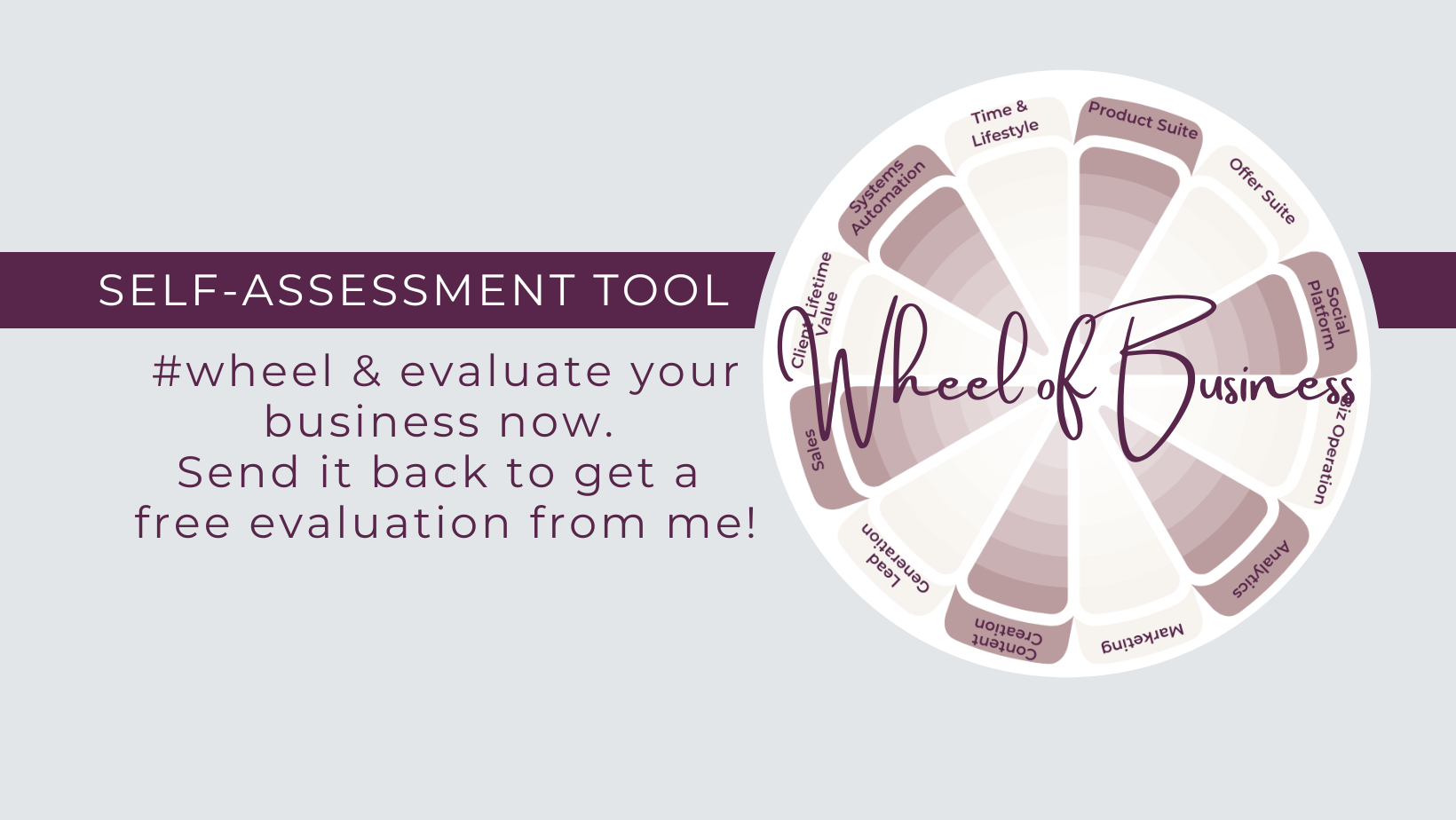
The Wheel of Business doesn't tell you what strategy to use. It tells you which area of your business system is currently creating drag on everything else — so you know where to direct your attention first.
How to read your Wheel results — and choose where to focus
Once you have scored all twelve categories, the next step is not to immediately fix the lowest number. The Wheel is a system — every area affects every other area — and the most useful starting point is almost always the area that is most connected to what you are actually trying to achieve right now.
Here is the process
| Step | What to do | Why it matters |
|---|---|---|
| Step 1 Score honestly |
Work through each of the twelve categories and assign a score from 1 to 6. One means absent or chaotic. Six means developed, tested, and functioning well. Score where the category actually is — not where you wish it were. | The exercise only produces useful information when the scores reflect reality. There is no advantage in inflating a number. |
| Step 2 Look at the full picture |
Once all twelve are scored, look at the whole Wheel. Notice which areas cluster at similar levels and which sit significantly lower or higher than the rest. | The Wheel is interconnected — every area affects every other area. A weakness in one creates pressure across several others simultaneously. |
| Step 3 Identify your lowest scores |
Note the one or two categories with the lowest scores. These are the areas currently creating the most drag on the rest of the system. | Low-scoring areas are important signals. They may be the direct cause of growth stalling — or they may be a symptom of another area needing attention first. |
| Step 4 Cross-reference with your core goal |
Look at your current primary business goal. Which of your lowest-scoring areas, if strengthened, would most directly support that goal? Choose one — maximum two — that align with both the score and the direction. | The right priority is not always the lowest score in isolation. It is the lowest score that is most connected to what you are actually trying to achieve right now. |
| Step 5 Choose one and go |
Choose one category to focus on this quarter. Implement one meaningful change in that area before evaluating what comes next. | Momentum comes from one area strengthened at a time — not from attempting all twelve simultaneously. A wheel that rolls steadily moves faster than a wheel spinning in every direction at once. |
The key insight is in Step 4. Your lowest-scoring category is an important signal — it tells you where the system is most underdeveloped. But the right area to focus on first is the one that is both low and most directly connected to your current core goal. Sometimes these are the same. Sometimes the lowest category is a symptom of a different area being weak first.
A simple example: if your core goal is to generate more consistent revenue and your lowest scores are in Sales and Analytics, strengthening Analytics first may be the smarter move — because without data, you cannot make informed decisions about your sales process, your pricing, or which offer to prioritise. Fixing the Sales score without the information to guide those decisions is guesswork.
The Wheel does not remove the need for judgment. It gives you an honest picture of the full system so that the judgment you apply is grounded in reality rather than the pressure of the most urgent-feeling thing.
Your lowest Wheel score is a signal. Cross-reference it with your core goal before deciding where to focus. The right starting point is where the score and the goal intersect.
What the Wheel is telling you about your business
Most businesses are not at the same score across the whole Wheel. That is completely normal — and it is actually the most useful thing the Wheel reveals.
Different areas develop at different speeds depending on your skills, your model, your stage, and what you have been focused on. You might be at a strong score in Content Creation and a weak score in Systems Automation — because you have been showing up consistently but everything still runs manually through you. You might score highly in Offer Suite but low in Lead Generation — because you have spent time perfecting what you sell but less time building a consistent mechanism for finding the people to sell it to.
None of these patterns mean something is wrong. They simply mean the Wheel is uneven. And an uneven Wheel — once you can see it clearly — tells you exactly where the most meaningful next investment of attention sits.
The Wheel also reveals something that most business advice misses: sometimes fixing one area immediately relieves pressure across several others at the same time. Strengthening Biz Operation often makes Content Creation feel easier, because the business has more structure to operate from. Strengthening Lead Generation often makes Sales feel less pressured, because there are more conversations happening. Improving Systems Automation often creates capacity across almost every other category, because it gives you back hours that were previously consumed by manual processes.
This is why the Wheel is revisited quarterly — not as a performance review, but as an ongoing calibration. The business that looked one way in January looks different in April. The areas asking for attention shift as the system develops. The Wheel tracks that evolution and keeps the focus grounded in what the system actually needs rather than what feels most urgent in the moment.
When you can see the whole system clearly — all twelve areas mapped honestly — the right next step almost always becomes obvious. The Wheel doesn't give you the answer. It reveals the answer that was already there.
Frequently asked questions
The Wheel of Business is a business diagnostic framework developed by Agnes Bogardi that maps an online business across twelve interconnected categories: Product Suite, Offer Suite, Social Platform, Biz Operation, Marketing, Analytics, Content Creation, Lead Generation, Sales, Client Experience and Delivery, Client Lifetime Value, and Systems Automation. Rather than treating a business as a linear funnel or a single strategy problem, the Wheel shows the business as a system and identifies which specific area is currently creating drag on the rest. Each category is scored from 1 to 6 and the Wheel is revisited quarterly to track progress and guide decisions.
The most common reason a business plateaus despite consistent effort is that the entrepreneur is addressing visible symptoms rather than the structural area that is actually limiting the system. Content gets improved when the real problem is lead generation. Offers get redesigned when the real problem is the sales process. More visibility is added when the real problem is that Biz Operation cannot support the clients already arriving. The Wheel of Business diagnostic reveals which of the twelve areas is creating drag on everything else — so effort can be directed at the thing that will actually create movement.
Start by scoring all twelve Wheel of Business categories honestly from 1 to 6. Then look at your lowest-scoring areas — these are where the system is most underdeveloped. The key is to cross-reference those low scores with your current core business goal. The right starting point is the category that is both low-scoring and most directly connected to what you are trying to achieve right now. Choose one area — maximum two — to focus on this quarter. Strengthening one thing at a time creates genuine momentum.
The twelve categories are: 1) Product Suite — what you offer and how your offers relate to each other. 2) Offer Suite — how your offers are packaged and priced. 3) Social Platform — where you show up publicly. 4) Biz Operation — the planning, processes, and financial awareness that keep the business running. 5) Marketing — how you communicate your value and reach your audience. 6) Analytics — tracking results and using data to make decisions. 7) Content Creation — the consistent content that builds trust over time. 8) Lead Generation — the systems that bring new potential buyers into your world. 9) Sales — converting interest into paying clients. 10) Client Experience and Delivery — everything after someone says yes. 11) Client Lifetime Value — retention, renewals, and long-term relationships. 12) Systems Automation — the tools and processes that allow the business to run beyond your direct manual involvement.
A business diagnostic for online entrepreneurs is a structured self-assessment that evaluates all core areas of the business simultaneously — not just the most visible or most painful one. Unlike a financial audit or a single-area marketing review, a business diagnostic gives you a complete picture of the system. The Wheel of Business is specifically designed for online service-based businesses — coaches, consultants, and practitioners — and uses a 1 to 6 stage scale per category that reflects the realistic development of each area over time.
Because you may be fixing the symptom rather than the source. In an interconnected system, the area that feels most broken is often not the area causing the problem — it is the area where the problem is most visible. When you fix the visible symptom without addressing the structural cause, the symptom either returns or shifts to a different area. The Wheel diagnostic is designed to show you the full system — so you can identify the area that, when strengthened, reduces pressure across multiple categories rather than addressing one surface symptom at a time.
Score yourself honestly from 1 to 6 across each of the twelve Wheel of Business categories. 1 means the area is absent or chaotic. 6 means it is developed, tested, and functioning well. Once all twelve are scored, look at the full picture — which areas are lowest, and which of those lowest scores connects most directly to your current core business goal. Choose one area — maximum two — to focus on. The full self-assessment worksheet is available at femmefortea.com/wob.
The most common reason is a structural imbalance in one or two specific areas that creates drag across the whole system — while the entrepreneur directs effort at more visible symptoms. In established businesses this is often an underdeveloped Lead Generation system, a fragile Sales process, or absent Systems Automation that leaves the owner as the bottleneck for everything. In early-stage businesses it is most often the absence of a clear Product Suite or Offer Suite — because without clarity at the foundation, every other area of the business operates without a stable direction.
Your business is not broken — it is uneven
The Wheel almost never comes back balanced. That is not a sign of failure — it is the normal state of a business at any stage of development. Different areas develop at different speeds depending on your skills, your model, your resources, and what you have been focused on.
What the Wheel gives you is the honest picture. And the honest picture — even when parts of it are uncomfortable — is infinitely more useful than continuing to fix the most visible thing and wondering why nothing changes.
Start with the full self-assessment at femmefortea.com/wob. Score each category for where your business actually is. Look at the full picture. Cross-reference your lowest scores with your current goal. Choose one area to focus on — and focus on it fully before moving to the next.
The Wheel rolls steadily when one area is strengthened at a time. That is how the momentum builds.
And if what you find when you look at your business clearly is that the areas are developing but growth still feels stuck — that the right people are not showing up, or that the people who find you are not converting — that points to something different. Not the Wheel, but the signal your business sends. That is the work of Buyer Signal Calibration™, and it is what the next article in this series addresses directly.
— Agnes Bogardi | FemmeFortea™ | femmefortea.com
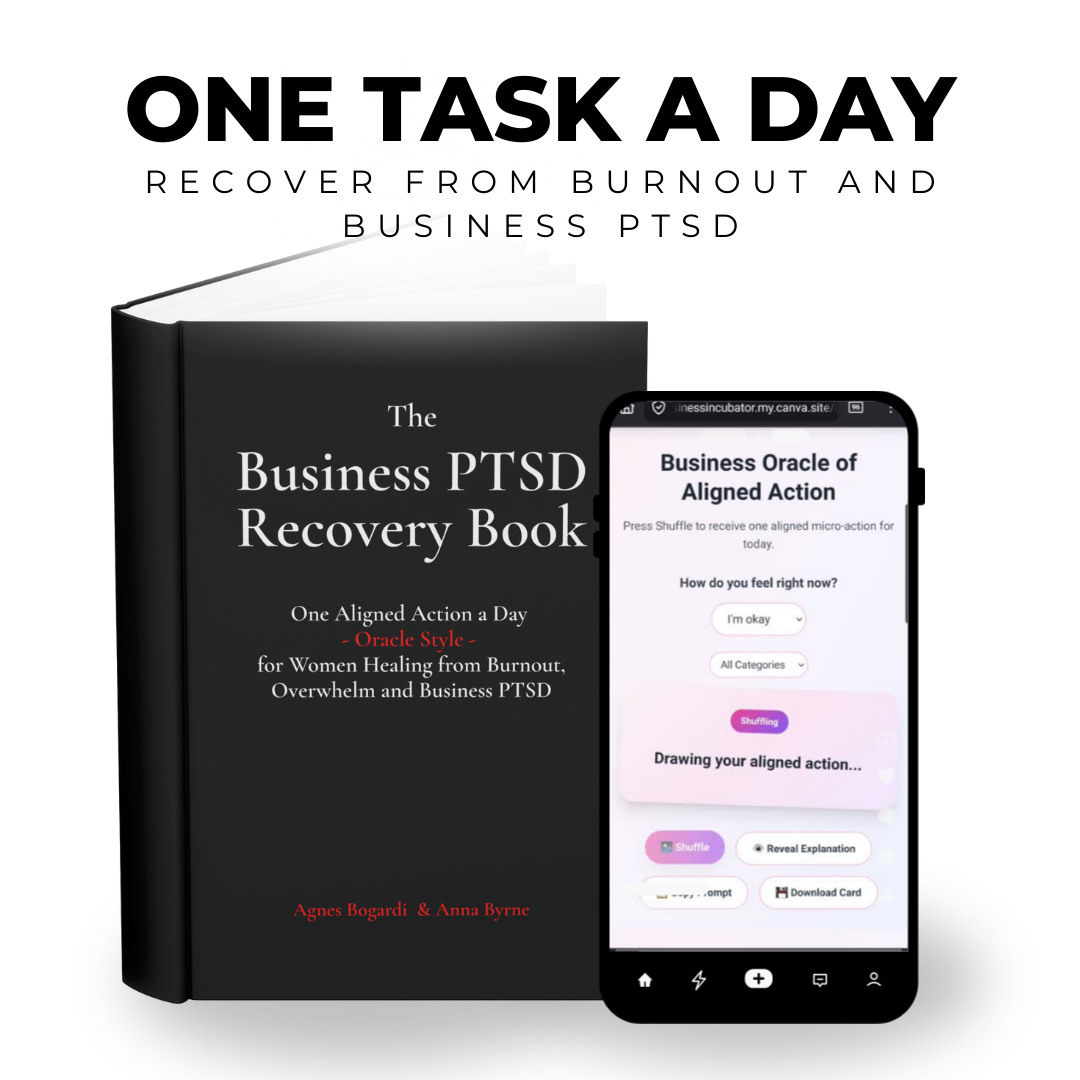
Have you lost confidence in your business after burnout?
Do you feel stuck, frozen, or overwhelmed, even though you still care deeply about your work?
Are you craving a gentler way to move forward without pushing, forcing, or breaking yourself again?
This book was created for women who have experienced chronic overwhelm, emotional exhaustion, or burnout in business and are ready to recover without pressure.