| Inspired Builder | She is full of vision, energy, and genuine excitement. The business feels like a calling. |
| Overloaded Achiever | Growth is happening but the pace is unsustainable. She is working harder than ever and starting to feel it. |
| Strained Entrepreneur | Something has shifted. The joy is thinning. She is still showing up but it costs more each time. |
| Burnout | She hits a wall. Exhaustion, cynicism, and a loss of motivation that feels like a personality change. |
| Business PTSD | The nervous system has restructured itself around the threat of business. Effort, visibility, and even opening a laptop trigger a protective shutdown. This is past burnout. |
| Recovery | With the right support — nervous system work, structural diagnosis, and gradual safe re-entry — she finds her rhythm again. One aligned action at a time. |
Entrepreneur burnout or business trauma? What happens when burnout stacks (and why tips won't fix it)
Most entrepreneur burnout content treats each burnout episode as an isolated event, something to recover from, then move past. But for a growing number of female entrepreneurs, burnout does not arrive once and leave.
It arrives, stacks on top of the last one, and eventually restructures the way the nervous system relates to business altogether.
When that happens, tips do not work. Boundaries do not work. Motivation challenges do not work. Because the problem is no longer situational, it is structural.
This article names that structural pattern: Business PTSD.
It explains the mechanism of burnout stacking, introduces the Business PTSD Spectrum, distinguishes business trauma from clinical PTSD, and offers the first step that actually changes things — which is not a strategy. It is a diagnosis.
What entrepreneur burnout actually is and what it quietly becomes
Entrepreneur burnout is real, widely studied, and increasingly talked about. The research is clear: more than half of entrepreneurs report experiencing burnout at least once a year, and the unique pressures of running your own business — financial uncertainty, isolation, the absence of anyone to hand things to when the weight gets heavy — make it categorically different from employee burnout.
Most of the content written about entrepreneur burnout treats it as a recoverable state. Rest. Boundaries. Delegate. Redefine success. These are reasonable interventions. For a first burnout episode, triggered by a clear external cause and caught early, they can work.
But there is something most burnout content does not address. Something that happens when burnout is not caught early. When it is pushed through instead. When recovery is incomplete, and the next launch begins, and the next disappointments, next "failure", next unfulfilled hopes, plans add up and the next burnout arrives sooner than the last one. When this cycle repeats — two times, three times, four times across a career — something changes that tips cannot reach.
The nervous system stops believing business is safe.
That is when entrepreneur burnout becomes something else. Something that does not have a widely used name yet. But it needs one — because naming it is the first step out of it.
When burnout stacks: the mechanism nobody names
Burnout stacking is what happens when recovery from one burnout episode is incomplete before the next cycle of pressure begins. Each incomplete recovery lowers the baseline from which the next burnout arrives. The entrepreneur is working with less capacity, less resilience, and less biological safety each time.
Here is how it progresses:
Burnout 1 arrives. It is painful, but the entrepreneur pushes through, rests briefly, and re-enters. She tells herself she has learned something. She will do it differently next time.
Burnout 2 arrives sooner, from a lower starting point. The recovery takes longer. The re-entry feels harder. She notices something has shifted but cannot name it.
Burnout 3 arrives without a clear external trigger. The patterns that used to energise her — creating, connecting, building — now feel heavy before she even begins. Her body starts to protest before her mind catches up.
By the fourth or fifth cycle, something structural has happened. The nervous system — which has been scanning for patterns and reading repeated effort without sustained reward as a threat signal — has restructured itself. Business is no longer neutral territory. Business is danger.
At this point, the entrepreneur is no longer experiencing burnout in the conventional sense. She is experiencing what happens after burnout has stacked enough times to become a pattern the nervous system actively defends against.
This is not a mindset problem. This is not a discipline, productivity, inspiration, motivation problem. This is biology doing exactly what it is designed to do: protecting her from further pain by shutting down the source of that pain.
The industry has no word for this. So she stays stuck, trying to fix a structural problem with situational solutions, wondering why nothing is working — and quietly concluding that the problem must be her.
It is not her. It is the stacking. And once you understand the mechanism, everything changes.
"Burnout stacking is not a character flaw. It is a physiological pattern the industry created — by pushing strategies without stage context, and rewarding persistence without recovery."
Business trauma: the bridge between burnout and what comes next
Before naming what Business PTSD is, it helps to name what lives between burnout and it: business trauma.
Business trauma is the accumulated weight of repeated disappointment, financial pressure, public failure, isolation, and self-doubt that accumulates across a business career. It is not one event. It is a pattern of events that, together, begin to shape how an entrepreneur relates to her work — not just how she feels about it in a given week, but what she expects from it, what she believes about herself inside it, and how her body responds when she tries to engage with it.
Business trauma is different from clinical or military trauma, and it is important to say this clearly. When most people hear the word trauma, they think of acute events — accidents, violence, loss, combat.
Business trauma is not that. It belongs to a specific category: the accumulated stress of entrepreneurship in an industry that rarely acknowledges the cost of what it asks of its people.
This is the cluster this article lives in: not soldiers, not childhood, not clinical PTSD — but the specific, undernamed experience of what happens to ambitious women who build businesses in environments that are structurally unsupportive, poorly sequenced, and designed to reward output without protecting the person producing it.
Business trauma is the bridge. It is what forms when burnout stacks. And when it is not addressed, it becomes Business PTSD
A note on language: PTSD, PTSI, and why injury is actually the more accurate word
You may encounter another term in this space: PTSI — Post-Traumatic Stress Injury. The distinction matters.
PTSD frames the experience as a disorder — something wrong with the person. PTSI frames it as an injury — something that happened to the person, something that can heal. Injury is the more accurate and more hopeful framing, because injuries have a structural cause, a clear mechanism, and a recovery path.
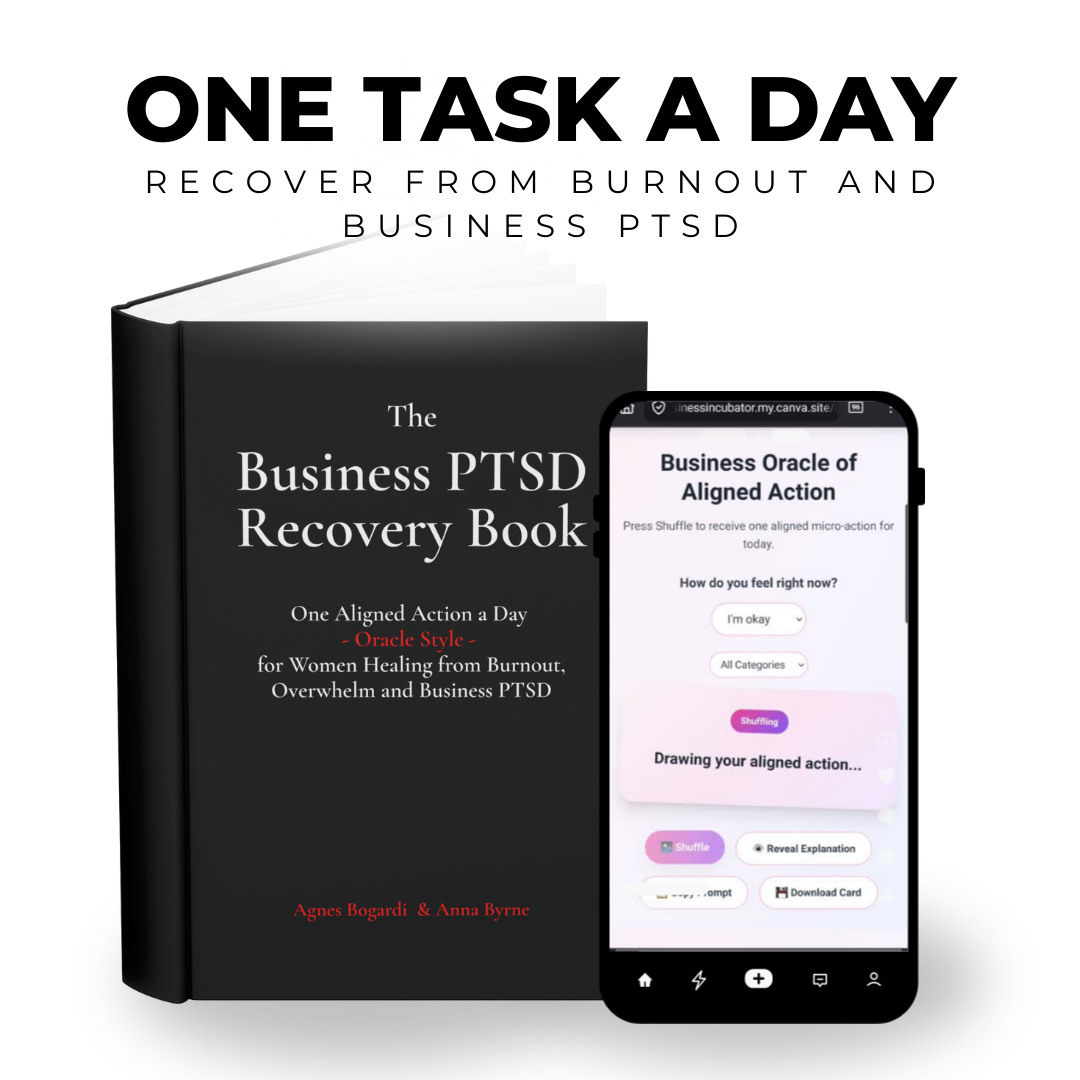
I use PTSD because that is the language most people recognise, and it is the term on the cover of The Business PTSD Recovery Book. But if PTSI resonates more honestly with your experience — if understanding this as an injury rather than a disorder changes how you hold it — please use that. The experience is the same. What you call it shapes how you approach healing it.
The key point, in either language: this is not who you are. It is what happened to you. And what happened to you has a name, a mechanism, and a way through.
What is Business PTSD — and how is it different from burnout
Business PTSD is what emerges when entrepreneurial stress, repeated disappointment, and incomplete recovery accumulate to the point where the nervous system begins to treat business-related activity as a threat signal. It is not a single burnout. It is the structural residue of burnout stacking — the point at which the pattern has embedded itself deeply enough to affect not just energy levels and motivation, but the body's automatic responses.
The difference between burnout and Business PTSD:
Burnout is situational. It is caused by identifiable external factors — overwork, a failed launch, a difficult client period, an impossible quarter. Remove or address the cause, recover properly, and the entrepreneur can re-enter.
Business PTSD is structural. The cause is no longer the current situation — it is what the nervous system learned from previous situations. Even a good situation can trigger a shutdown because the body has learned to protect itself from the pattern, not just the specific event.
The Business PTSD Spectrum maps the full journey from inspired beginning to recovery. It is not a linear diagnosis — people enter at different points, and recovery is not always sequential. But it gives language to a progression that most entrepreneurs have lived but could not name:
Where are you on this spectrum right now? Not where you think you should be. Where you actually are. That honest answer is the beginning of recovery.
The 7 signs you may be past burnout
These are not motivational deficits. They are not laziness, weakness, or evidence that entrepreneurship is not for you. They are nervous system signals — the body's communication that something structural needs attention.
1. You cannot open your laptop. Not because you are procrastinating. Because something in your body physically resists the action — a tightening in the chest, a heaviness, a sense of dread that arrives before you have even done anything.
2. You freeze before taking action. You know exactly what you need to do. You have the plan. And you cannot start. The gap between knowing and doing has become a chasm that effort alone cannot cross.
3. The push-crash cycle has become your normal. You have periods of forcing yourself to work at full capacity, followed by complete collapse — days or weeks of doing nothing, which leads to self-blame, which feeds the next push. The cycle repeats. You wonder when it will stop.
4. Business activity produces physical symptoms. Anxiety, shallow breathing, tightness in the chest, headaches, nausea, exhaustion that is not explained by sleep deprivation. The body is communicating what the mind is trying to manage.
5. Self-blame has become structural. You are not occasionally frustrated with yourself. You have internalised a story that you are the problem — too inconsistent, too sensitive, too much, not enough. This story arrived after the burnout stacking began, not before it.
6. The things that used to energise you no longer do. Creating, connecting, building — the activities that once felt like purpose now feel like performance. You go through the motions. The spark is absent.
7. Recovery strategies stop working. Rest used to help. Now it does not. Journaling used to shift your perspective. Now it feels like going in circles. You have tried the things that worked before and they are no longer working — because the problem has changed.
If more than three of these resonate, this is not burnout as conventionally defined. This is what happens after burnout stacks. And it requires a different kind of attention — not more tips, not more strategy, not more pushing through. It requires a diagnosis of what has actually happened, and a structured path back to safety.
Why the industry's advice keeps failing you
The advice is not wrong. Boundaries are important. Rest is important. Delegation matters. Community matters. For a first burnout episode — caught at the right stage, addressed with the right support — these interventions can work.
The problem is what the industry does not tell you: these strategies are stage-specific. They are designed for burnout at the Overloaded Achiever or early Strained Entrepreneur stage. They are not designed for what happens after burnout has stacked three or four times. They are not designed for Business PTSD.
Applying burnout tips to Business PTSD is like applying a plaster to a structural injury. The plaster is not wrong — it is just addressing the wrong level of the problem. And when the plaster does not work, the entrepreneur typically concludes: I must be the problem. Everyone else seems to recover from burnout. I cannot get my act together.
That conclusion is false. And it is one of the most damaging things the industry's silence on this topic produces.
When pushing harder does not work — when more consistency, more content, more strategy, more courses all fail to shift the pattern — it is not because the entrepreneur lacks discipline or commitment. It is because she is trying to solve a structural problem with surface-level tools. More strategy applied to Business PTSD does not create momentum. It creates more stacking.
The first thing that actually changes this is not a new strategy. It is naming what has actually happened. Seeing the pattern clearly — the stacking, the nervous system response, the structural nature of the problem — is not a small thing. It is the beginning of recovery.
More strategy applied to Business PTSD does not create momentum. It creates more stacking. The first intervention is not a plan — it is a diagnosis.
Frequently asked questions
Entrepreneur burnout is situational — it is caused by identifiable external pressures and resolves with proper recovery, rest, and structural changes. Business PTSD is what emerges when burnout stacks repeatedly without complete recovery between cycles. The nervous system begins to treat business activity as a threat signal, producing automatic protective responses — freezing, avoidance, physical symptoms — that are no longer triggered by the current situation but by what the body learned from previous ones. The key distinction: burnout responds to situational interventions. Business PTSD requires structural work at the nervous system level.
Burnout stacking is the pattern that occurs when recovery from one burnout episode is incomplete before the next cycle of pressure begins. Each incomplete recovery lowers the baseline — the entrepreneur enters the next cycle with less capacity, less resilience, and less biological safety. Over multiple cycles, this progressive depletion restructures the nervous system's relationship to work. Burnout stacking matters because it explains why standard burnout advice stops working after a certain point: the problem is no longer about the current situation but about a pattern the body has learned over time.
PTSI stands for Post-Traumatic Stress Injury. The key distinction is in the framing: PTSD describes a disorder — something wrong with the person. PTSI describes an injury — something that happened to the person, which can heal. Many clinicians and researchers prefer PTSI because it more accurately reflects the structural, recoverable nature of the experience and removes the stigma of disorder language. In the context of business and entrepreneurship, PTSI may be the more useful frame — the entrepreneurial experience injured the nervous system, and that injury has a diagnosis and a recovery path.
Yes — though the terminology differs from clinical PTSD associated with acute trauma events. What emerges from repeated cycles of entrepreneurial stress, disappointment, financial pressure, isolation, and burnout stacking is a pattern the nervous system encodes as a structural threat response. This is not the same as PTSD from combat or acute trauma, but it operates through similar nervous system mechanisms: the body learns to protect against a perceived ongoing threat. In the business context, this is what Agnes Bogardi terms Business PTSD — a distinct pattern with its own progression, signs, and recovery path.
Business trauma typically presents as a persistent and growing difficulty engaging with business activity — not in a specific task or area, but across the board. Signs include: inability to open a laptop or begin working without a physical stress response; the push-crash cycle becoming the dominant work pattern; self-blame that has become structural rather than situational; recovery strategies that used to work no longer having effect; a growing sense that the problem is the person, not the situation. Business trauma is the accumulated weight of repeated disappointment and pressure that has restructured the entrepreneur's automatic responses to her work.
Entrepreneur burnout keeps returning when recovery is incomplete between cycles. The business world — and much of the coaching industry — normalises pushing through burnout and re-entering quickly. Without complete recovery and a structural diagnosis of what caused the burnout, the pattern repeats. Each cycle begins from a lower baseline. Over time, this is burnout stacking — and the recurring pattern is not a failure of willpower but a predictable consequence of incomplete recovery and wrong-stage strategy.
When the nervous system has learned to associate business activity with threat, pushing harder amplifies the threat signal. The body does not distinguish between productive effort and dangerous overextension — it responds to the pattern it has learned. More effort on top of an unaddressed nervous system response produces more activation, more depletion, and faster stacking. This is why the standard advice to be more consistent or push through resistance actively worsens Business PTSD. The system needs safety signals, not more pressure.
Recovery from Business PTSD happens in stages: diagnosis first (naming the pattern and identifying where you are on the Spectrum), followed by nervous system work (creating safety signals before attempting business re-entry), then gradual structured re-engagement (small, completing actions that rebuild the nervous system's association of business with safety rather than threat), and finally strategic rebuilding (the right strategy for the right stage). Agnes Bogardi's Business PTSD Recovery Model maps this journey across three dimensions: nervous system healing, belief repair, and strategic rebuilding.
The Business PTSD Spectrum is a framework developed by Agnes Bogardi that maps the progression from inspired beginning through overload, strain, burnout, Business PTSD, and into recovery. It is not a linear diagnosis — people enter at different stages and move through it non-sequentially. Its primary function is diagnostic: helping an entrepreneur locate herself honestly on the spectrum so that the right intervention can be applied at the right stage. The six stages are: Inspired Builder, Overloaded Achiever, Strained Entrepreneur, Burnout, Business PTSD, and Recovery.