Why Do I Keep Burning Out? The Business Trauma Loop Explained
If you have burned out more than once — if you have recovered, rebuilt, and then found yourself in the same place again — this is the article that explains why. Not because you are inconsistent, weak, or not cut out for this.
But because you have been cycling through a specific 6-step structural pattern that nobody in the business world has given a name to.
Until now.
The Business Trauma Loop is the repeating cycle of Hope, Intense Effort, Disappointment, Self-Blame, Withdrawal, and Hope Again — a loop that rebuilds itself automatically until the structure underneath it is addressed.
This article names every step, explains what feeds it, and maps the exit.
You swore it wouldn't happen again
You know this moment.
The moment you realise you are here again. Burned out again. Exhausted again. Staring at the same wall you swore you would never find yourself in front of after last time.
And the most devastating part is not the burnout itself. It is the familiarity of it. The recognition that something you were certain you had learned from, moved past, and survived is somehow happening again — despite everything you did differently this time.
You showed up more consistently. You invested more carefully. You built better boundaries. You did the mindset work. You rested properly before re-entering. And you are still here.
If this is your experience, you are not failing at recovery. You are caught in a cycle — a specific, structural, repeating pattern that looks different each time but follows the same six steps every time. And until that cycle is named and understood at a structural level, it cannot be broken. It can only be repeated.
The Business Trauma Loop is the name for what you have been living through. And naming it is the first step out of it.
You are not burning out because you lack discipline. You are burning out because you are cycling through a structural pattern that rebuilds itself every time — until the structure is addressed.
Why burnout keeps coming back — what nobody tells you
The standard answer to 'why do I keep burning out' is personal. Perfectionism. Poor boundaries. Identity tied to productivity. An overachiever mindset. These are real factors — but they are surface-level explanations for what is actually a structural problem.
Here is what the burnout content industry does not tell you: each episode of burnout is not isolated. It is one iteration of a repeating cycle. And the cycle repeats not because you have not learned from it, but because the structure underneath the cycle has not changed.
You can change your habits, your mindset, your schedule, and your strategy — and still find yourself in the same place three months later. Because the loop is structural. It does not care how much you have improved. It runs on the structural residue of every previous cycle, and it will keep running until that residue is addressed directly.
This is what distinguishes the Business Trauma Loop from a single burnout episode:
A single burnout episode has a clear cause, resolves with rest and structural changes, and does not automatically repeat.
The Business Trauma Loop is a cycle that regenerates itself. It has a beginning, a middle, and an end — and the end connects directly back to the beginning. Rest alone does not break it. Neither does a new strategy. The loop itself must be identified and interrupted.
The reason this matters is not academic. It is practical. Every time the loop runs without being named, it deposits more structural damage — more evidence in the nervous system that business effort leads to disappointment, more self-blame becoming permanent story, more withdrawal becoming the default response to pressure. Over time, this is how burnout stacking becomes Business PTSD.
Breaking the loop is not about trying harder. It is about seeing the loop clearly enough to step out of it — and that begins with the six steps.
The Business Trauma Loop — the 6-step cycle that explains everything
The Business Trauma Loop follows the same sequence every time. The specific content changes — different launches, different strategies, different coaches, different offers. But the structural shape of the experience is identical across every cycle.
Read each step. Notice which one you are in right now.
| Step | What it feels like from the inside | What makes it lead to the next step |
|---|---|---|
| 1. Hope | Fresh start energy. A new idea, a new strategy, a new version of herself. Genuine excitement. Genuine commitment. | The hope is real — it is not naivety. It is the nervous system's reset mechanism. But it resets into the same structural loop. |
| 2. Intense Effort | She goes all in. Works harder than before, invests more, shows up more consistently. This is her favourite phase — it feels like proof that she is serious. | The effort is real and substantial. The problem is that effort alone cannot fix a structural signal or a misaligned strategy for her stage. |
| 3. Disappointment | The results do not match the effort. The launch underperforms. The clients do not arrive. The audience engages but does not buy. The gap between input and output is devastating. | The disappointment is the moment the nervous system records a new data point: effort leads to pain. This is where the structural damage begins. |
| 4. Self-Blame | She concludes she is the problem. Not the strategy, not the timing, not the stage mismatch. Her. Too inconsistent, not skilled enough, missing something the successful ones have. | Self-blame is the most damaging step because it prevents structural diagnosis. If she is the problem, there is nothing structural to fix — only herself to improve, which sends her back to step 1. |
| 5. Withdrawal | She steps back. Goes quiet. Stops creating, stops investing, stops showing up. This looks like rest. It is not rest — it is the nervous system protecting itself from another round of effort and disappointment. | Withdrawal without diagnosis means nothing structural changes during this phase. She recovers enough to feel hope again — but the loop is still intact. |
| 6. Hope Again | Something shifts. A new idea arrives. A new strategy catches her attention. A new offer promises a different result. The hope returns — genuine, real, unguarded. The loop begins again. | This is the cruelest step. The hope is indistinguishable from the hope that started the last cycle. Without naming the loop, she cannot see that she has been here before. |
One thing worth noticing: none of these steps are irrational. Every response makes sense given what came before it. The hope is real. The effort is real. The disappointment is real. The self-blame, the withdrawal, the returning hope — all of it is a rational response to the previous step.
The loop is not a sign of weakness or poor judgment. It is a structural pattern that operates below the level of conscious decision-making. Which is why awareness alone rarely breaks it — and why naming it is necessary but not sufficient.
The Business Trauma Loop is not evidence that something is wrong with you. It is evidence that something structural has been running underneath everything you have been trying to fix on the surface.
The three layers feeding the loop
The loop does not sustain itself on its own. Three distinct layers feed it — and understanding all three is what makes it possible to interrupt rather than just endure.
Layer 1 — Industry Conditioning. The business industry rewarded the push and never named the cost. Hustle culture, consistency mandates, visible activity as a measure of seriousness — all of these created the conditions for the loop to form. The industry taught you that effort should produce results, that disappointment means something is wrong with your execution, and that the solution to a failed strategy is a better strategy. None of these teachings account for the structural damage accumulated across cycles. The industry created the loop and then sold you solutions that kept you inside it.
Layer 2 — Personal Business PTSD. With each cycle of the loop, the nervous system records a new data point: effort leads to disappointment. Over multiple cycles, this becomes a structural pattern — the body begins to anticipate disappointment before the effort even begins. This is how Business PTSD forms from the loop: the nervous system stops experiencing each cycle as fresh and starts responding to the pattern it has learned. By the time this layer is active, hope itself has become a trauma trigger — because hope is what precedes the effort that precedes the pain.
Layer 3 — Nervous System Dysregulation. The loop is no longer running consciously. The body is running it automatically — producing the physiological states of activation, depletion, and protective withdrawal without needing a cognitive decision at each step. This is why 'just be more consistent' or 'just push through' not only does not work but actively makes the structural damage worse. You cannot consciously override a pattern that is being generated below the level of conscious thought.
These three layers reinforce each other. Industry conditioning feeds personal PTSD. Personal PTSD drives nervous system dysregulation. Nervous system dysregulation makes the industry's surface-level solutions feel impossible to implement. The loop tightens.
Breaking it requires addressing all three — not just the surface strategy, not just the mindset, not just the rest. The structural pattern needs to be named, the nervous system needs safety, and the industry's framing needs to be replaced with something that actually accounts for the human cost of the cycle.
What breaks the loop — and what doesn't
This is the section most burnout content skips. It is the most important one.
What does NOT break the Business Trauma Loop:
A new strategy — applied to an unaddressed structural pattern, a new strategy is the beginning of the next loop cycle. It is the Hope step with different content.
More accountability — accountability for showing up consistently only works when the structural loop has been interrupted. Before that point, it adds pressure to a nervous system that is already running in protection mode.
Rest alone — rest between cycles is the Withdrawal step. Without structural diagnosis and intervention, it is simply the pause before the loop restarts.
Mindset work — the loop is not generated by limiting beliefs. It is generated by a structural pattern embedded in the nervous system. Changing the belief does not change the pattern.
A new coach or program — without addressing the three feeding layers first, a new coach is the most expensive way to fund the next iteration of the loop. The Endless Investor pattern runs on this mechanism specifically.
What DOES break the Business Trauma Loop:
Naming the loop and the step you are currently in — recognition is not resolution, but it is the only starting point. You cannot interrupt a pattern you cannot see.
Addressing the nervous system layer first — safety signals before strategy. Small completing actions that teach the body that business activity can end in completion rather than disappointment.
Changing the pattern, not just the episode — the loop is structural. Breaking it means changing the structure: what happens after disappointment, what follows withdrawal, what the next Hope step is built on.
Diagnosis before investment — understanding which step of the loop you are in before committing to the next strategy, program, or coach. The Business Trauma Loop feeds on unexamined hope.
The first break in the loop is almost always the same: stopping and naming where you are with complete honesty. Not the step you wish you were in. Not the step you should be in by now. The step you are actually in — right now.
The new pattern that replaces the loop
Breaking the loop does not mean replacing it with another cycle of ambition and effort. It means replacing the entire structure with something that does not generate the loop's conditions in the first place.
The structure that replaces the Business Trauma Loop has three stages — and the sequence matters. They cannot be reversed.
| Safety | The nervous system learns that business activity is survivable again. Small completing actions. No pressure for results. Just safe movement forward. |
| Capacity | From a foundation of safety, capacity begins to rebuild. Energy returns. Clarity returns. The entrepreneur can hold more without triggering the protective shutdown. |
| Sustainable Growth | Strategy re-enters — but matched to current capacity and current stage. Not the most ambitious strategy. The right strategy for right now. |
This is not a slower version of the loop. It is a different structure entirely. The loop runs on hope → effort → disappointment. The new pattern runs on safety → capacity → growth. One is driven by external results. The other is driven by internal stability.
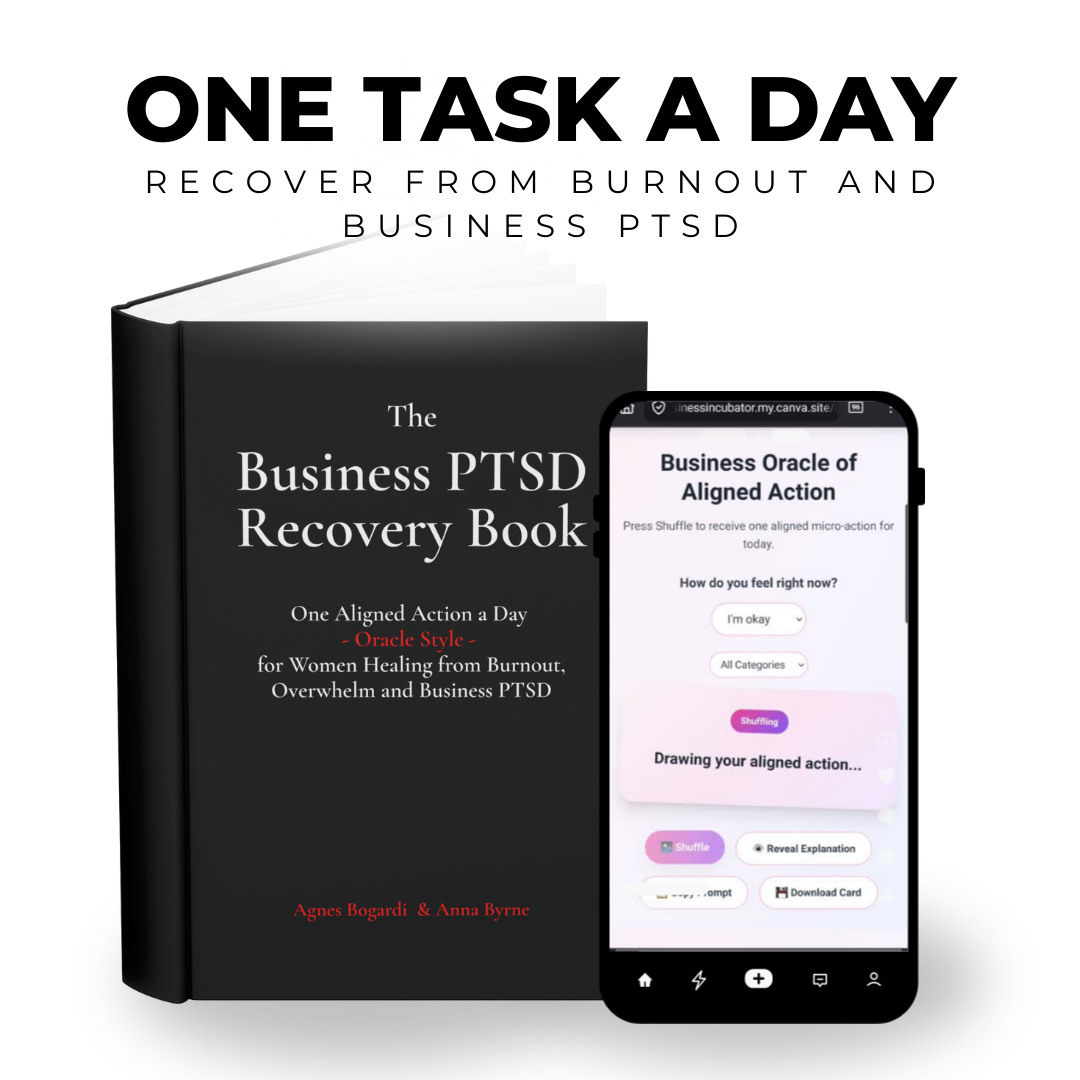
The Business PTSD Recovery Book — one aligned action per day, designed to be safe and completable from wherever you currently are — was built to walk the Safety stage of this structure. Not because the bigger strategies are not important. But because without safety, the loop simply restarts regardless of what the strategy is.
The Business PTSD Recovery Hub takes the full structure further: a diagnostic process that identifies which step of the loop you are currently in, which of the five Business PTSD patterns is dominant, and what the specific first intervention is — before any new strategy is introduced.
Recovery from the Business Trauma Loop is not about doing more. It is about doing something structurally different. And that starts here — with the name.
Frequently asked questions
The Business Trauma Loop is a 6-step repeating cycle that explains why entrepreneur burnout keeps returning even when the entrepreneur has learned from previous episodes and genuinely tried to do things differently. The six steps are: Hope, Intense Effort, Disappointment, Self-Blame, Withdrawal, and Hope Again. The loop is structural — it is generated by the accumulated nervous system damage of previous cycles combined with industry conditioning and nervous system dysregulation. Agnes Bogardi identified and named this pattern as part of the Business PTSD Recovery framework.
Because the changes you are making are happening at the surface level — strategy, habits, mindset, schedule — while the Business Trauma Loop is operating at a structural level underneath those changes. Each attempt to do things differently is the beginning of a new cycle of the loop, not a break from it. The loop sustains itself through three feeding layers: industry conditioning, personal Business PTSD accumulated across previous cycles, and nervous system dysregulation that runs the pattern automatically. Changing the surface does not change the structure.
Burnout keeps returning because what feels like separate episodes is actually one continuous structural cycle — the Business Trauma Loop — repeating with different content each time. Each cycle ends in Withdrawal and then restarts with Hope, which feels like a fresh beginning but is structurally connected to the previous cycle. Without naming and interrupting the loop itself, rest and recovery between cycles do not break the pattern — they are the Withdrawal step of the loop, followed by the next Hope.
The hope-effort-disappointment sequence is the first three steps of the Business Trauma Loop — the most visible part of the cycle and the one most entrepreneurs recognise when it is named. Hope arrives genuinely, intense effort follows, and when results do not match effort, disappointment lands. What makes this sequence a loop rather than a one-off experience is what follows the disappointment: self-blame, withdrawal, and then hope again — connecting the end of the cycle back to the beginning and restarting the pattern.
Feeling burned out without obvious cause is one of the signs that the loop has moved past simple burnout into Business PTSD territory. When the nervous system has recorded enough cycles of effort leading to disappointment, it begins to generate the burnout response in anticipation — before effort begins, sometimes before the thought of business activity is even completed. The body is protecting itself from a pattern it has learned to predict. This is nervous system dysregulation, not laziness or weakness.
Repeated burnout across multiple cycles is one of the primary indicators that the Business Trauma Loop has been running long enough to produce Business PTSD. When rest stops restoring full capacity, when effort produces less return each cycle, and when the protective withdrawal phase gets longer, the structural damage of Business PTSD is likely present. The Business Trauma Loop is the mechanism through which Business PTSD forms over time.
Breaking the Business Trauma Loop requires three things in sequence: first, naming the loop and identifying which of the six steps you are currently in; second, addressing the nervous system layer before introducing any new strategy — creating safety signals through small completing actions; and third, replacing the loop's structure with the new pattern of Safety, Capacity, and Sustainable Growth — in that order. The most common mistake is jumping directly from Withdrawal back into a new strategy without completing the safety phase, which restarts the loop rather than breaking it.
Burnout recovery does not last when it addresses the episode rather than the loop. Resting from a specific burnout episode is the Withdrawal step of the Business Trauma Loop — it provides relief from the immediate depletion but leaves the structural pattern intact. When the recovery period ends and hope returns, the loop restarts. Lasting recovery requires structural intervention: naming the loop, working with the nervous system at a body level, and rebuilding from a foundation of safety rather than re-entering the same structural conditions that generated the previous cycle.
Burnout is a state — a period of physical, emotional, and mental exhaustion with identifiable causes and a recovery path. The Business Trauma Loop is a structural pattern — a 6-step cycle that generates burnout repeatedly and rebuilds itself automatically between episodes. Burnout can be addressed with situational interventions such as rest, boundaries, and structural changes. The Business Trauma Loop requires a different approach: identifying the loop itself, understanding its three feeding layers, and replacing the structural pattern rather than addressing individual episodes.
Have you lost confidence in your business after burnout?
Do you feel stuck, frozen, or overwhelmed, even though you still care deeply about your work?
Are you craving a gentler way to move forward without pushing, forcing, or breaking yourself again?
This book was created for women who have experienced chronic overwhelm, emotional exhaustion, or burnout in business and are ready to recover without pressure.
You are not the problem.
The loop is.
If you have read this article and recognised yourself in the six steps — if you can see, perhaps for the first time, that what you have been experiencing is not a personal failure but a structural pattern — let that land for a moment.
You were not weak. You were not inconsistent. You were not behind or broken or wrong for this. You were cycling through a structural loop that the business world created, normalised, and then sold you solutions to that kept you inside it.
The loop has a name now. And named things can be interrupted.
The Business PTSD Recovery Book offers one aligned action per day — safe, small, completable from whatever step of the loop you are currently in. It does not ask for a fresh start or a new strategy. It asks for one step.
The Business PTSD Recovery Hub takes the structural work further: a full diagnostic process, pattern identification, and a recovery sequence built specifically for the loop and the stage you are in — not a generic path, but the one that matches where you actually are.
And if what brought you here is not just the burnout loop but also the question of why your content and offers are not converting despite showing up — that is a different structural problem. One that belongs to the Buyer Alignment world. The link between these two frameworks is not accidental: Business PTSD affects signal. The wrong signal attracts the wrong buyer. And fixing one without addressing the other produces a business that feels better inside but still does not convert.
Both paths start the same way. With a name. With seeing the structure clearly. You just did that.
— Agnes Bogardi | FemmeFortea™ | femmefortea.com