Burnout recovery that actually works — the 5 Business PTSD patterns and why most advice targets the wrong one
Most burnout recovery advice is generic — and generic advice applied to the wrong pattern produces more stacking, not less. The reason burnout keeps returning for so many female entrepreneurs is not a lack of effort or self-awareness. It is that the recovery strategy does not match the specific pattern of Business PTSD the entrepreneur is in. The Frozen Operator needs something completely different from the Hustle Survivor. The Quiet Dream Keeper cannot use the same entry point as the Endless Investor. This article introduces the 5 Business PTSD patterns — named, defined, and distinguished from each other — and explains what each pattern actually needs. If burnout recovery has not worked for you so far, this is likely why.
Why burnout recovery advice keeps failing the people who need it most
Burnout recovery is one of the most searched topics in the entrepreneurship space — and one of the most consistently mishandled. Not because the advice is wrong. Much of it is reasonable: rest, boundaries, delegation, support networks, nervous system regulation. These are real tools.
The problem is not the advice. The problem is the assumption underneath it — that all burnout is the same, that all entrepreneurs arrive at burnout through the same pattern, and that the same recovery strategy will work for everyone who has hit a wall.
It will not. And the evidence is everywhere: the entrepreneur who rests and comes back only to burn out again within months. The one who invests in another coach and finds herself in the same place a year later. The one who pushes through because that is what has always worked — until it suddenly doesn't anymore.
What these women have in common is not a lack of commitment to recovery. What they have in common is that the recovery strategy they were given was designed for a different pattern than the one they are actually in.
Business PTSD — the structural residue of repeated burnout stacking, where the nervous system has learned to treat business activity as a threat — does not arrive in a single shape. It arrives in five distinct patterns, each with its own mechanism, its own internal monologue, and its own recovery entry point.
Until you know which pattern you are in, burnout recovery is guesswork. And guesswork at this stage of depletion is expensive — in time, in money, and in the trust the entrepreneur has left in her own ability to recover.
"Burnout recovery fails when the strategy doesn't match the pattern. There are five patterns of Business PTSD — and each one needs a completely different first step."
Before the patterns: what makes Business PTSD different from burnout
If you have not read the first article in this series — Entrepreneur burnout or business trauma? What happens when burnout stacks — a brief orientation is useful here.
Business PTSD is what emerges when burnout stacks repeatedly without complete recovery between cycles. The distinction from standard burnout matters because the recovery path is different:
Burnout is situational. Address the cause, recover properly, re-enter. The nervous system returns to a baseline state of relative safety.
Business PTSD is structural. The nervous system has reorganised itself around the accumulated pattern of threat. Even when the external situation improves, the body continues to respond as though danger is present.
This structural nature is why standard burnout recovery strategies stop working after a certain point. They address the situation. The situation has already been processed. What remains is the pattern the body learned from it.
The five patterns below describe five distinct ways Business PTSD manifests — five different shapes the structural damage takes, depending on the entrepreneur's history, personality, and the specific sequence of events that led her here.
Most women recognise one pattern immediately and see traces of a second. That is normal. The patterns are not mutually exclusive — but there is almost always a dominant one, and that dominant pattern is what determines the right recovery entry point.
The 5 patterns of Business PTSD
Pattern 1 — The Frozen Operator |
WHO SHE IS She is not struggling with knowing what to do. She has the knowledge, the plan, the offers, often the audience. What she cannot do is start. Paralysis is the dominant experience — a gap between intention and action that effort alone cannot close. She often appears capable and organised from the outside, which makes the internal experience of being unable to move feel even more confusing and shameful. She may have been high-functioning for years before arriving here. HER INTERNAL MONOLOGUE "I know exactly what to do. I just cannot make myself do it." WHAT MAKES THIS PATTERN DISTINCT The Frozen Operator's pattern is specifically about the action gap — not about strategy, not about skill, not about motivation in the conventional sense. The freeze is a nervous system response, not a character defect. Her business knowledge is intact. Her capacity to act on it has been structurally interrupted. WHAT DOES NOT HELP Productivity frameworks. Accountability partners who add external pressure. Motivational content that tells her to 'just start.' Journaling about why she is stuck. All of these address the mind — the problem is in the body's automatic response to the idea of beginning. WHAT SHE ACTUALLY NEEDS Safety signals before strategy. Her nervous system needs to learn that small actions are survivable before larger ones become possible. One completing action — finished, done, small — rebuilds the association between business activity and safety. This is not about finding motivation. It is about rewiring the threat response one safe step at a time. |
The Frozen Operator doesn't have a motivation problem. She has a nervous system that learned action is dangerous. Those are not the same thing. - Agnes Bogardi
Pattern 2 — The Endless Investor |
WHO SHE IS She has invested significantly in her recovery and her business — coaches, courses, masterminds, rebrands, new niches, new platforms. Each investment brings genuine hope, a period of momentum, and then the same result. She is not naive or reckless. She is someone whose nervous system learned to associate 'new investment' with 'possible escape from the pattern' — and that association has become its own cycle. She is often financially depleted alongside being emotionally depleted. HER INTERNAL MONOLOGUE "Maybe this next thing will finally be the one that works." WHAT MAKES THIS PATTERN DISTINCT The Endless Investor's pattern is specifically about the repetition of external solution-seeking as a response to an internal structural problem. No external solution can fix a structural nervous system pattern. The investment cycle is not irrational — each new investment genuinely feels like it could be different. But without addressing the underlying pattern first, it cannot be. WHAT DOES NOT HELP Another program. Another coach — even a good one — before the structural pattern is identified. More information, more tools, more investment in any form. The cycle needs to be interrupted before the next step can be useful. WHAT SHE ACTUALLY NEEDS A structural diagnosis before any further investment. She needs to understand what she is actually trying to fix — and confirm that what she is investing in addresses that specific thing, not a surface symptom of it. The Business PTSD Recovery Hub's diagnostic tools exist for exactly this: identifying the root pattern before selecting the recovery path. |
The Endless Investor is not naive. She is someone trying to solve a structural problem with external tools — and that gap is exactly what needs diagnosing first. — Agnes Bogardi
Pattern 3 — The Hustle Survivor |
WHO SHE IS She has survived every previous burnout by pushing through. Her track record of resilience is real and substantial. She has gotten through things that would have stopped most people, and she knows it. Her identity — to herself and often to others in her life — is built on this capacity. Which makes the current moment, in which pushing is not working, profoundly disorienting. She does not know who she is when she is not the one who pushes through. HER INTERNAL MONOLOGUE "I just need to push harder. I have gotten through worse than this." WHAT MAKES THIS PATTERN DISTINCT The Hustle Survivor's pattern is specifically about the identity dimension of Business PTSD. Her recovery strategy — more effort, more discipline, more showing up — is the same strategy that produced the burnout stacking in the first place. Each attempt to push through from this pattern adds more to the structural load rather than reducing it. Her resilience is real. It is also, at this stage, working against her. WHAT DOES NOT HELP Any framing of recovery as 'pushing through differently.' Reframing rest as 'productive recovery.' Any language that makes stopping sound like strategic output. Her nervous system will translate this back into permission to keep pushing. The pattern needs a genuine interrupt, not a reframe. WHAT SHE ACTUALLY NEEDS Permission to stop — from someone she respects, framed clearly, without productivity language attached. And a gradual identity expansion that separates her worth from her output. She does not need to stop being a resilient person. She needs to discover that she is still herself when she is not performing resilience. |
The Hustle Survivor's greatest strength became her greatest obstacle. Recovery begins the moment she discovers she is still herself when she stops. — Agnes Bogardi
Pattern 4 — The Visibility Protector |
WHO SHE IS She has retreated. Not because she lost interest in her business or her work, but because at some point the cost of being visible became too high. The inconsistency, the judgment, the results not yet matching the effort — all of it became publicly visible in a way that felt unsafe. Her retreat is not laziness. It is a sophisticated protective response to a nervous system that has learned: showing up leads to pain. HER INTERNAL MONOLOGUE "If I put myself out there and it doesn't work again, I won't recover from it." WHAT MAKES THIS PATTERN DISTINCT The Visibility Protector's pattern is specifically about the association between public presence and threat. Her business may be fully formed in her mind. The offers exist, the thinking has been done. But the pathway between private capability and public expression has become structurally blocked. She often continues working intensely behind the scenes while appearing completely absent to her audience. WHAT DOES NOT HELP Launch strategies. Visibility challenges. Accountability for posting consistently. Any pressure to 'just show up' that does not first address what showing up became associated with. These strategies are designed for someone who has not yet experienced the threat of public visibility — not for someone whose nervous system learned that visibility is dangerous. WHAT SHE ACTUALLY NEEDS Graduated re-entry. One small, low-stakes act of visibility — not a comeback, not a launch, not a full content strategy. Something that her nervous system can hold without triggering the protective shutdown. Over time, small completed acts of visibility rebuild the association between showing up and safety. The strategy comes after the nervous system is ready for it — not before. |
The Visibility Protector is not hiding. She is protected by a nervous system that learned that showing up leads to pain. The strategy comes after that changes. — Agnes Bogardi
Pattern 5 — The Quiet Dream Keeper |
WHO SHE IS She has not given up. The dream is still fully present — she can feel it, describe it, be moved by it. What she cannot seem to do is move toward it. She is often described by people around her as someone with 'so much potential,' which over time becomes its own kind of weight. She does not need more encouragement or more vision work. She needs something smaller and more specific: a single safe step she can actually take. HER INTERNAL MONOLOGUE "I haven't given up. I just don't know how to start moving again." WHAT MAKES THIS PATTERN DISTINCT The Quiet Dream Keeper's pattern is specifically about the gap between vision and capacity — not a gap in commitment or clarity, but a gap in the nervous system's ability to translate the clear internal picture into external movement. She often knows exactly what she wants and exactly what she is not doing. The knowing makes it harder, not easier. WHAT DOES NOT HELP Vision board exercises, manifesting practices, or any process that amplifies the distance between where she is and where she wants to be. Positive psychology framing that implies she simply needs to 'believe more.' Comparison to others who are moving. These all increase the weight of the gap rather than reducing it. WHAT SHE ACTUALLY NEEDS One aligned action — not a plan, not a strategy, not a challenge. A single, small, completing step that requires almost nothing of her and produces a real result. The Business PTSD Recovery Book was built for this moment specifically: one action per page, each one designed to be safe, small, and actually completable from wherever she currently is. |
The Quiet Dream Keeper doesn't need more vision. She needs one safe step small enough that her nervous system can actually hold it. — Agnes Bogardi
Which pattern are you? A quick reference
Read each internal monologue in the table below. One of them will land differently than the others — not as a description of someone else, but as a sentence you have actually said to yourself. That is your pattern.
| Pattern | Her internal monologue | What she actually needs |
|---|---|---|
| The Frozen Operator | "I know exactly what to do. I just cannot make myself do it." | Safety signals before strategy. Small completing actions that rebuild trust with herself. |
| The Endless Investor | "Maybe this next thing will finally be the one that works." | A diagnosis of the structural problem — not another external solution layered on top of it. |
| The Hustle Survivor | "I just need to push harder. I have gotten through worse than this." | Permission to stop. Recognition that stopping is not quitting — it is the first recovery step. |
| The Visibility Protector | "If I put myself out there and it doesn't work again, I won't recover." | Graduated re-entry. Visibility rebuilt one small safe action at a time, not a full comeback strategy. |
| The Quiet Dream Keeper | "I haven't given up. I just don't know how to start moving again." | One aligned action — not a plan, not a strategy. A single safe step that her nervous system can hold. |
If two resonate — which is common — notice which one feels like the more recent, more active experience. That is likely the dominant pattern right now. Patterns can shift over time, and recovery from one can reveal a second underneath it.
Why the same burnout recovery advice fails all five patterns
The standard burnout recovery framework — rest, boundaries, self-care, support, gradual re-entry — is not wrong. For someone at an early stage of burnout, before Business PTSD has become structural, it can work.
But applied universally across all five patterns, it produces very different results:
For the Frozen Operator, 'rest more' increases the freeze. The nervous system interprets extended inactivity as confirmation that action is dangerous.
For the Endless Investor, 'find the right support' triggers another investment cycle — this time in a recovery program — without addressing whether the structural pattern has been identified first.
For the Hustle Survivor, 'be kinder to yourself' is translated by her nervous system as permission to be productive again. She comes back too soon, from a higher place of self-awareness but the same depleted baseline.
For the Visibility Protector, 'just show up consistently' is precisely the threat her nervous system has learned to protect against. The advice re-triggers the shutdown it is trying to resolve.
For the Quiet Dream Keeper, 'connect with your vision' increases the weight of the gap between where she is and where she wants to be. More vision work from a depleted baseline produces more paralysis, not more momentum.
This is not a failure of the advice. It is a failure of the assumption that all burnout is the same pattern requiring the same response. The diagnosis has to come before the prescription. And the diagnosis has to be specific.
The industry gives you the same recovery advice regardless of which pattern you are in. That is why it keeps not working. The diagnosis has to come before the prescription.
The pattern does not define you — it orients you
Naming your pattern is not a diagnosis of limitation. It is a map.
The Frozen Operator is not someone who cannot act — she is someone whose nervous system learned that action is dangerous, and whose recovery begins with making action safe again. The Hustle Survivor is not someone who is too tough for her own good — she is someone whose extraordinary resilience has been running without a sustainable foundation, and whose recovery begins with discovering that she is still herself when she stops.
Every pattern has a recovery path. Every pattern has a specific first step that is actually available from where she is right now — not from where she wishes she was, not from the version of herself before the stacking began.
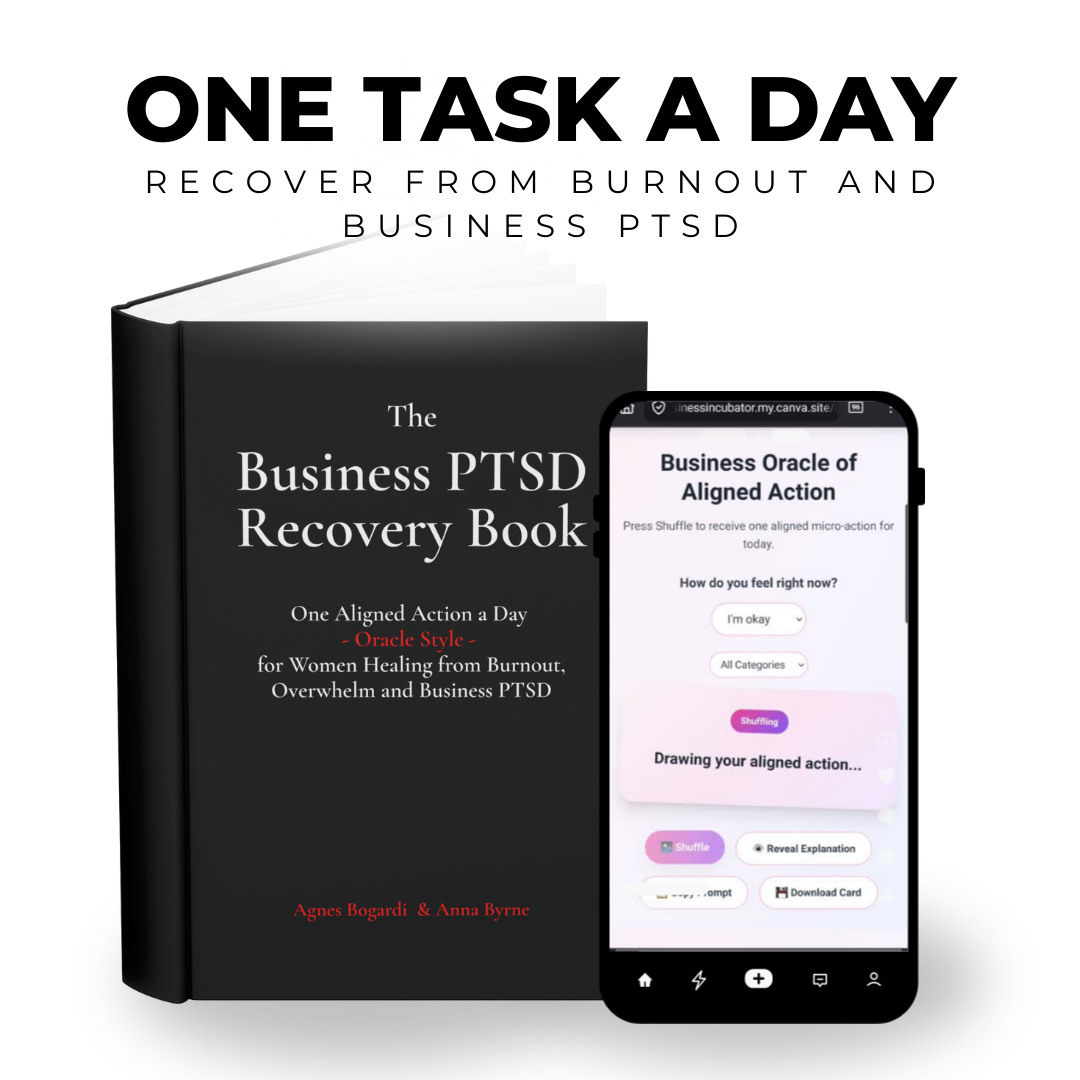
The Business PTSD Recovery Book — written by Agnes Bogardi and breathwork specialist Anna Byrne — offers one aligned action per day, designed to be safe and completable from any of the five patterns. It does not ask for more than is currently possible. It asks for one step.
The Business PTSD Recovery Hub takes the diagnosis further: a structured programme that identifies your dominant pattern, maps your position on the Business PTSD Spectrum, and builds a recovery sequence that matches where you actually are — not a generic path, but the one that fits your specific pattern and stage.
Recovery is not about becoming someone different. It is about finding the path back to who you already are — with a nervous system that believes business is safe again.
Frequently asked questions
The 5 patterns of Business PTSD are: The Frozen Operator (knows what to do but cannot start — paralysis is the dominant experience), The Endless Investor (cycles through external solutions without addressing the structural root), The Hustle Survivor (pushes through using the same strategy that created the stacking), The Visibility Protector (has retreated from public presence as a nervous system protective response), and The Quiet Dream Keeper (holds the vision clearly but cannot translate it into movement). Each pattern has a distinct mechanism, internal monologue, and recovery entry point.
The Frozen Operator is a Business PTSD pattern characterised by a specific gap between knowing and doing. The person in this pattern typically has the knowledge, the plan, and often the audience — but her nervous system has learned to respond to business activity as a threat, producing an automatic freeze response before action begins. This is not procrastination in the conventional sense. It is a structural nervous system response that effort, accountability, and motivation strategies cannot reach. Recovery begins with safety signals — small, completing actions that rebuild the body's association between business activity and safety.
The conventional 5 stages of burnout framework describes a progression through a single burnout episode. The 5 Business PTSD patterns describe what emerges after burnout has stacked repeatedly — the five distinct shapes that structural nervous system damage takes depending on the entrepreneur's history, personality, and sequence of events. The patterns are not stages of a single burnout. They are distinct structural configurations, each requiring a different recovery entry point.
Yes — and most people recognise traces of two patterns when they read the descriptions. The patterns are not mutually exclusive. However, there is almost always a dominant pattern — the one that is most active, most recent, and most structurally present right now. The dominant pattern determines the right first step in recovery. As recovery progresses and the dominant pattern shifts, a secondary pattern may become more visible and require its own attention.
In the context of the Hustle Survivor pattern, resilience becomes counterproductive when it is applied to a structural problem that requires stopping rather than continuing. The Hustle Survivor has learned that pushing through produces results — and historically, it has. But applied to Business PTSD, pushing through adds more stacking to an already structurally damaged foundation. Each push from a depleted baseline lowers that baseline further. The resilience is real. The problem is that it is being used as a recovery strategy when recovery actually requires a genuine interrupt.
Business PTSD shares nervous system mechanisms with clinical PTSD — specifically the restructuring of automatic responses around learned threat signals — but it is distinct in its cause and context. Clinical PTSD typically involves acute traumatic events. Business PTSD emerges from the accumulated stress of entrepreneurship: repeated burnout stacking, financial pressure, isolation, public failure, and the specific demands of building and running a business in an industry that rarely provides adequate context or support. It is not the same as workplace PTSD or clinical PTSD, and it does not require the same clinical treatment — though nervous system work is central to recovery from both.
The fastest way to identify your dominant pattern is through the internal monologue. Read the five internal monologues described in this article. One of them will feel less like a description and more like a sentence you have actually said to yourself — possibly recently. That is your pattern. If two resonate, identify which one feels most active right now. The Business PTSD Recovery Hub includes a full diagnostic process that maps your dominant pattern alongside your position on the Business PTSD Spectrum, and builds a recovery sequence specific to your combination.
The Quiet Dream Keeper is a Business PTSD pattern characterised by the persistent presence of vision alongside an inability to move toward it. The person in this pattern has not given up — the dream is intact and often clearly articulated. What has been disrupted is the nervous system's capacity to translate that internal clarity into external action. She is often told she has so much potential, which over time becomes its own weight. What she needs is not more vision work or more encouragement, but a single completing action small enough that her nervous system can hold it without triggering the shutdown that more ambitious steps produce.
Burnout recovery for female entrepreneurs requires a pattern-specific approach that accounts for the structural dimensions of Business PTSD — not just the situational triggers of a single burnout episode. Female entrepreneurs face specific burnout risk factors: the double burden of business and domestic responsibility, higher rates of impostor syndrome and financial anxiety, and an industry that has historically been built around male models of productivity and resilience. Effective burnout recovery for this group begins with pattern identification, proceeds through nervous system work and belief repair, and then — and only then — moves into strategic rebuilding. Reversing that sequence is the most common reason recovery fails.
Your pattern is not your destiny — it is your starting point
Naming the pattern is not a verdict. It is a compass.
If you recognised yourself in the Frozen Operator, your starting point is not a new strategy — it is one action small enough that your body can hold it. If you are the Endless Investor, your starting point is the diagnosis that comes before the next investment. If you are the Hustle Survivor, your starting point is the hardest thing you have ever done: stopping.
If you are the Visibility Protector, your starting point is not a comeback plan — it is one small, private act of presence that your nervous system can complete without shutting down. And if you are the Quiet Dream Keeper, your starting point is exactly what it sounds like: one aligned action. Not a plan. Not a strategy. One step.
The Business PTSD Recovery Book offers that one step — and then the next one, and the one after that — at the pace your nervous system can actually hold. The Business PTSD Recovery Hub takes you further: a structured path from diagnosis through recovery and into strategic rebuilding, specific to your pattern and your stage.
You are not behind. You are not broken. You are someone who has been applying the wrong strategy to the wrong pattern — and now you know which pattern you are actually in.
That changes everything.
Yours truly,
Agnes Bogardi | FemmeFortea™ | femmefortea.com
Have you lost confidence in your business after burnout?
Do you feel stuck, frozen, or overwhelmed, even though you still care deeply about your work?
Are you craving a gentler way to move forward without pushing, forcing, or breaking yourself again?
This book was created for women who have experienced chronic overwhelm, emotional exhaustion, or burnout in business and are ready to recover without pressure.